
Article
The History of Angel Oracles: From Ancient Temples to Digital Card Readings
The desire to receive guidance from something beyond our everyday awareness is one of the oldest human impulses. Long before anyone shuffled a deck of angel cards or asked an online oracle a yes or no question, people were traveling hundreds of miles to consult oracles, interpreting patterns in nature, and developing elaborate systems for accessing unseen wisdom.
The angel oracle as you know it today, a deck of beautifully illustrated cards with names and meanings designed to guide personal reflection, is the product of a long and fascinating evolution. Understanding that history gives your practice depth and context. You are not just drawing cards. You are participating in a tradition that stretches back thousands of years.
The Ancient Oracles: Where It All Began
Mesopotamia and Egypt
The earliest known oracle practices date back to ancient Mesopotamia, roughly 4,000 years ago. Babylonian priests practiced divination by examining the entrails of sacrificed animals, reading patterns in oil poured on water, and interpreting the movements of stars and planets. These were not casual activities. Oracles were state institutions, consulted before wars, harvests, and major political decisions.
In ancient Egypt, oracles operated within temple complexes. Priests served as intermediaries, presenting questions to statues of deities and interpreting their responses through various mechanisms: the movement of the statue (carried on a processional boat), the behavior of sacred animals, or the drawing of lots. The concept of a mediating figure between the questioner and unseen wisdom, which survives in modern angel card readings, has its earliest roots here.
The Oracle at Delphi
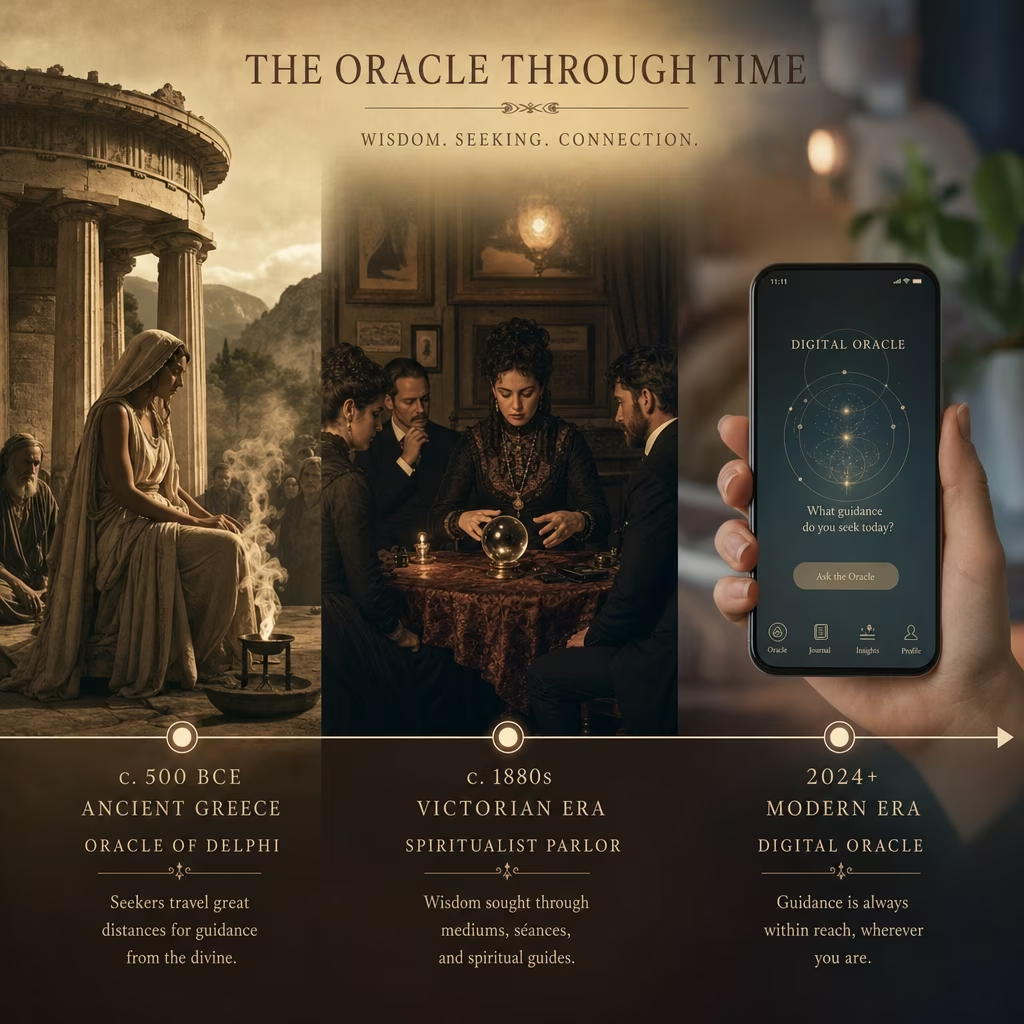
The most famous oracle in the ancient world was the Oracle at Delphi in Greece, active from roughly the 8th century BCE until the 4th century CE. The Pythia, a priestess seated over a fissure in the earth, would enter an altered state and deliver pronouncements in response to questions from visitors ranging from farmers to kings.

What made Delphi remarkable was its structure. It was not a spontaneous act of prophecy. It was an institution with rituals, procedures, and a trained intermediary. Visitors prepared their questions, made offerings, and received guidance through an established process. If that sounds familiar, it should: modern oracle readings follow the same basic pattern of preparation, question, and interpretation.
Rome and the Classical World
Roman culture absorbed Greek oracle traditions and added its own methods. Augury, the interpretation of bird flight patterns, was an official practice. The Sibylline Books, a collection of oracular pronouncements, were consulted during national crises. And the concept of a personal genius or guiding spirit, what the Romans called a "genius" for men and a "juno" for women, planted the seed for the later idea of a personal guardian presence.
The Medieval and Renaissance Periods
As European culture shifted through the medieval period, oracle practices did not disappear. They transformed. Astrology remained a respected discipline through the Renaissance, practiced by scholars and consulted by rulers. Alchemy, with its symbolic language and layered meanings, developed parallel systems of interpretation that would later influence card-based divination.
The Tarot emerged in 15th-century Italy, initially as a card game. Over the following centuries, occultists and scholars gradually attributed symbolic, divinatory meanings to the cards. By the 18th century, figures like Jean-Baptiste Alliette (known as Etteilla) and Antoine Court de Gebelin had established Tarot as a tool for self-knowledge and divination.
This transition from game to spiritual tool is important, because it established the template that angel oracle cards would later follow: a deck of illustrated cards, each carrying symbolic meaning, used by individuals to access personal insight. To understand how angel cards eventually diverged from Tarot, see our comparison of angel cards vs tarot.
Your free Oracle reading
A free daily reading that puts words to what you already feel.
Trusted by 10k+ users worldwide
Victorian Spiritualism and the Birth of Angel Themes
The 19th century brought a dramatic shift. The Spiritualist movement, which began in the 1840s in the United States and spread rapidly through Europe, normalized the idea of communicating with unseen beings and accessing non-physical guidance in everyday life.
Victorian-era interest in angels surged during this period. Angels became a prominent subject in art, literature, and popular culture, portrayed as personal guardians and messengers. The idea that every person has a guardian angel watching over them, while much older in origin, became widely popularized in this era.
Simultaneously, the popularity of card-based readings grew. Fortune-telling cards, distinct from Tarot, appeared in parlors and salons across Europe and America. These decks were simpler, more direct, and often featured angelic or celestial imagery. The foundation for modern angel oracle cards was being laid.
The 20th Century: Modern Oracle Decks Emerge
The 20th century saw two key developments. First, the mid-century occult revival, driven by figures like Aleister Crowley and later by the New Age movement of the 1970s and 1980s, brought oracle and Tarot practices into mainstream awareness. Bookstores began carrying decks alongside self-help books, and oracle readings shifted from parlor entertainment to personal development tools.
Second, angel-specific oracle decks began appearing in the 1990s and 2000s. These decks deliberately departed from Tarot's complex structure (78 cards, Major and Minor Arcana, suit systems) in favor of simpler, more intuitive designs. Each card in an angel oracle deck typically carries a single theme, a clear image, and an accessible message. The emphasis shifted from fortune-telling to self-reflection and personal guidance.
This accessibility was intentional. Angel oracle creators wanted to remove the intimidation factor that sometimes surrounds Tarot and make card-based guidance available to everyone. Our guide for beginners on how to read angel cards reflects this same philosophy.
The Digital Revolution: Oracles Go Online
The most recent chapter in this history is unfolding right now. Digital oracle platforms have taken the principles developed over millennia, the structured question, the symbolic intermediary, the interpretive response, and made them available to anyone with an internet connection.
The Yes No Oracle represents a particular milestone in this evolution. With a deck of 44 original angel cards, each bearing a unique evocative name, and eight distinct reading types, it is a purpose-built digital oracle system rather than a digitized version of a physical deck. The cards, the interpretations, and the reading formats were designed from the ground up for the digital experience.
This matters because it is not simply old practices forced into new technology. It is a genuine evolution of the oracle tradition, one that preserves the core elements, the pause, the question, the symbolic response, the personal interpretation, while embracing the reach and immediacy of the digital world. You can explore this system through a free oracle reading anytime.
What Stays the Same Across 4,000 Years
Despite the enormous changes in form, from temple priestesses to printed cards to digital platforms, the essential structure of oracle consultation has remained remarkably consistent:
- A question is formulated. Whether spoken to a Delphic priestess or typed into a screen, the act of clarifying what you want to know is always the first step. Our guide on how to ask a yes or no question continues this ancient practice.
- A symbolic intermediary provides a response. Bird flights, oil patterns, card images, digital card draws: the specific medium changes, but the function is the same.
- The questioner interprets the response. No oracle has ever simply said "do this." The response always requires the questioner to reflect, interpret, and apply the message to their own situation.
- The process creates a pause. In every era, the oracle's greatest gift is the same: it interrupts the rush of daily life and creates a space for deeper awareness.
Why History Matters for Your Practice
Knowing this history does not change how you draw a card or ask a question. But it changes how you understand what you are doing. You are not engaging in a modern novelty. You are participating in one of the oldest forms of human self-reflection, updated for the world you live in but connected to practices that predate writing itself.
The next time you sit down for a reading, whether you use the angel oracle cards guide or simply draw a single card, remember: you are doing something that humans have done for four thousand years. The tools change. The need for guidance, clarity, and connection with something beyond the everyday mind does not.